
While Bharat Biotech's Covaxin is in trials among children already, Serum Institute of India will begin Novavax vaccine trials on children from July, whereas the Pfizer vaccine has been approved for adolescents in the United States; and Cadila Healthcare's ZyCoV-D has done trials on 12 year-olds and above already, reports Sohini Das.
The trial is to be conducted on 525 healthy volunteers. In the trial, the vaccine will be given by intramuscular route in two doses at day 0 and day 28.
No decision on granting indemnity to any foreign or Indian Covid vaccine-manufactures has been taken yet, the government said Friday, underlining these decisions are to be taken 'in the interest of nation and people'.

The panel was informed that the economic impact of the second wave of viral infection was "asynchronous in its onset and wider in its spread particularly in rural hinterland", a source said.
The vaccine candidate -- 'Covaxin' -- is being indigenously developed by the Bharat Biotech in collaboration with the Indian Council of Medical Research (ICMR).
According to government sources, the matter was discussed by the national expert group on vaccine administration for COVID-19 in its last meeting held on August 22.
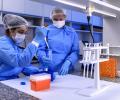
The Indian government and private firms have stepped up efforts to develop a vaccine to halt the spread of COVID-19 which has claimed over 3,700 lives with more than 1,25,000 cases in the country.
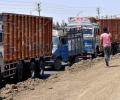
With the government asking the companies to operate with only 50 per cent staff strength, and exports dipping to almost zero, the truck and bus drivers idling at the petrol pump say they hardly have any work now. At a petrol pump on the deserted Bavla-Changodar highway near Ahmedabad in Gujarat, several trucks and buses are neatly parked in a row.

The prime minister was happy that the assurance given by the Serum Institute that it will make India self-sufficient in vaccines at the lowest possible price in the world was fulfilled.
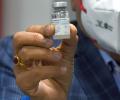
The Subject Expert Committee on COVID-19 of the CDSCO on October 12 after deliberating Bharat Biotech's EUA application had recommended granting emergency use approval to Covaxin for use in the 12-18 years age group with certain conditions.
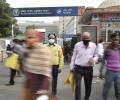
The phase-three human clinical trial of indigenously developed anti-coronavirus vaccine candidate Covaxin began at the AIIMS in New Delhi on Thursday, with Dr M V Padma Srivastava, the chief of Neurosciences Centre at the premier institute, and three other volunteers receiving the first dose.
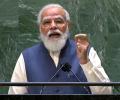
Prime Minister Narendra Modi, in his address at the 76th session of the United Nations General Assembly on Saturday, invited the global manufacturers of vaccines to come and make vaccines in India, stressing that the country's "faith is to serve people".

This is because while the emergency authorisation for treating Covid was a recent move, the drug has been used since years for rheumatoid arthritis and autoimmune lupus.
'Antibodies remain in the blood for at least seven to nine months.'
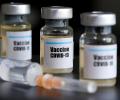
'Pfizer India has submitted an application on December 4 to the DCGI seeking emergency use authorization for its COVID-19 vaccine in India'
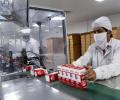
When compared to the domestic sales of April 2019, the growth is around 37 per cent. However, compared to the previous month (March), the growth is 18.4 per cent.
Dr V K Paul, Member (Health) Niti Aayog, who also chairs the national expert group on COVID-19 vaccine administration, said the government attaches 'great importance to this offer of partnership from a very special friend to this nation'.
A senior official at the health ministry told ANI: "For HCQ, we have placed orders for about 11.45 crore tablets to two Indian firms -- IPCA laboratories and Zydus Cadila. So far, we have received 6.64 crore HCQ drugs and remaining will arrive by May 16."

According to sources, around 10 crore doses of the Sputnik V vaccine is likely to be imported for emergency use in the country in the next six to seven months.

The Serum Institute of India, Bharat Biotech and Pfizer have applied to the DCGI seeking emergency use authorisation for their COVID-19 vaccine candidates and are awaiting approval.

The modalities of COVID-19 vaccine delivery, distribution and administration were discussed during the meeting.

The official expressed hope on the success of the five vaccines that are under different phases of trial in the country.
India will export anti-malarial drug hydroxychloroquine, high in demand globally, only to foreign governments and not to private companies, as the product is under prohibited or banned category of exports, sources said. Although exports of this medicine is completely banned, India has decided to export this anti-malarial drug in sync with its global commitment to deal with the coronavirus pandemic.
India is not keen to 'bow down' to demands related to indemnity against legal liabilities in case any vaccine recipient develops severe adverse reactions post inoculation.
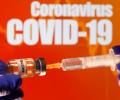
The Serum Institute of India, the largest vaccine maker in the world, has been chosen by Oxford and its partner AstraZeneca to manufacture the vaccine once it is ready. Trials results for the first two phases were published earlier this month.
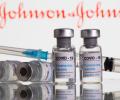
According to the sources, there are limited prospects of J&J exporting its vaccine from the US to other countries in the near future and the "entire production" at the BE facilities in India, beginning July/August, will be handed over to the pharma giant under a contract between the companies.

'India is a pharma dada. We can manufacture enough for our people and for the world.'
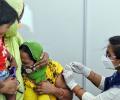
Experts, however, feel that given the intensity of the second wave and the high single dose coverage, India is in a good position to avoid any drastic wave in the near future.
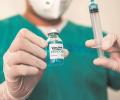
The novel mRNA vaccine candidate, HGCO19, is supported with seed grant under the Ind-CEPI mission of the Department of Biotechnology. The mRNA vaccines do not use the conventional model to produce immune response. Instead, they carry molecular instructions to make the protein in the body through a synthetic RNA of the virus.
Zydus plans to initiate the clinical trials of ZyCoV-D in July 2020 across multiple sites in India. In animal studies the vaccine was found to elicit a strong immune response in multiple animal species like mice, rats, guinea pigs and rabbits.
The procurement and distribution will be centralised though the government is yet to take a call on the initial number of doses that will be procured.

The Central Drugs Standard Control Organisation has granted restricted emergency use authorisation to two new vaccines and a drug for COVID-19, taking the number of preventives and treatments available in India to 12.
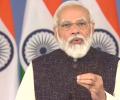
In an address to the nation amid increasing Covid cases through the Omicron variant of the virus, he said the precaution dose will also be available for citizens above 60 years of age and with comorbidities on the advice of their doctor from January 10 next year as well.

Apart from the 1.1 crore doses of Covishield being procured from the Serum Institute of India, 55 lakh doses of indigenously developed Covaxin were being obtained from Bharat Biotech, Union Health Secretary Rajesh Bhushan said at a press conference.
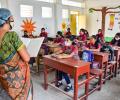
Only half India's population has received the first shot of Covishield and Covaxin and the government's immediate task is to first vaccinate its adult population before placing its focus on children.

Five vaccine candidates are in advanced stages of development in India, out of which four are in Phase II/III and one is in Phase-I/II trials.
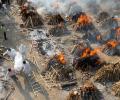
A second wave of Covid driven by the Delta variant engulfed the country in May-June bringing the health system to its knees and leaving people gasping for help.

Replying to a short duration discussion on COVID-19 management in Rajya Sabha, the minister said technology transfer to several companies has started and they will begin production in the coming days to reduce vaccine shortage in the country.
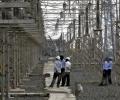
For India Inc, latest GDP figures signal a turnaround.
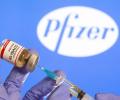
At $37 per dose, the Pfizer vaccine is much more expensive compared to $3 per dose for the Covishield.
